What the Science Actually Says about AI (and What I Tell My VCE English Students)

As a Literature purist, I am fiercely protective of my students’ creativity and thought process. But as the mentor and tutor to so many ambitious Year 12s, I also understand the pressures you’re under: the need to see effort translate into results, the brutally limited time you have to secure entry into your dream courses, and the temptation to reach for whatever tool gets the job done.
Having spent the past year training in learning sciences, educational technology, and instructional design at the epicentre of AI and Education, Columbia University in New York City, I have a thing or two to say about how AI fits into all of this.
Disclaimer, I’m not anti-AI. What I am against is the version of AI that hollows out the very skills VCE English is built to develop (and they matter more than you think!), and the version that leaves measurable damage on learning. The good news is, though, the line between “AI is helping me” and “AI is robbing me” is actually quite clear once you understand what’s happening inside your head when you write.
How AI works
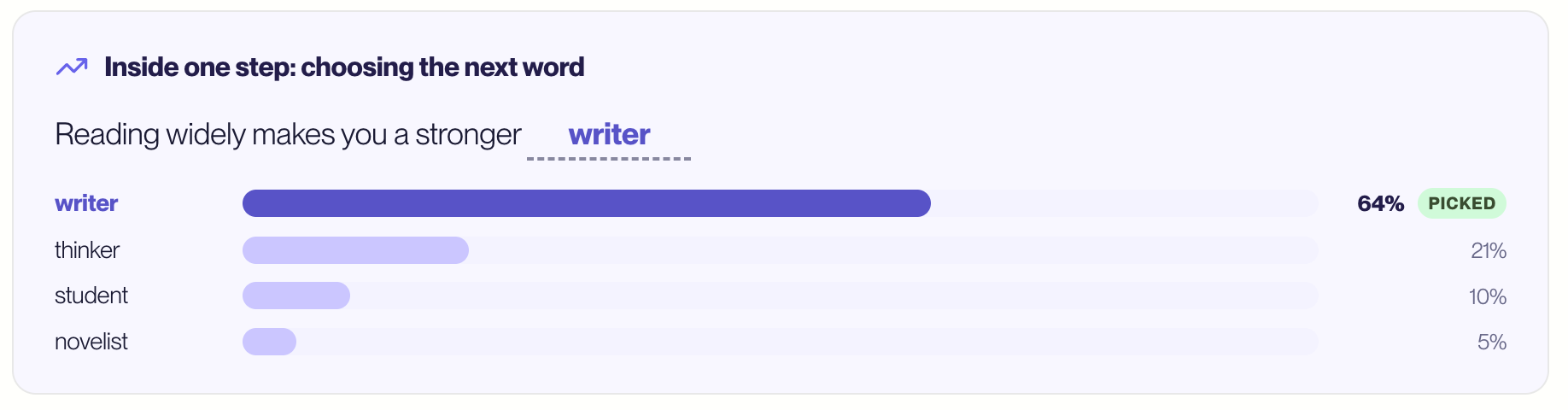
Artificial intelligence generates probabilistic outputs based on your inputs. Feed it a prompt, and it returns the most likely sequence of words given its training data. As impressive as it may seem, AI is not wizardry, and cannot come up with precisely written, original analysis out of thin air. This matters enormously for VCE English students because your assessors are not looking for the most probable essay. Instead, they're looking for great argumentation, original voice, and analytical judgement. AI, by design, trends toward the average and assessors definitely aren’t looking for average. Well, unless average marks is what you’re looking for ;)
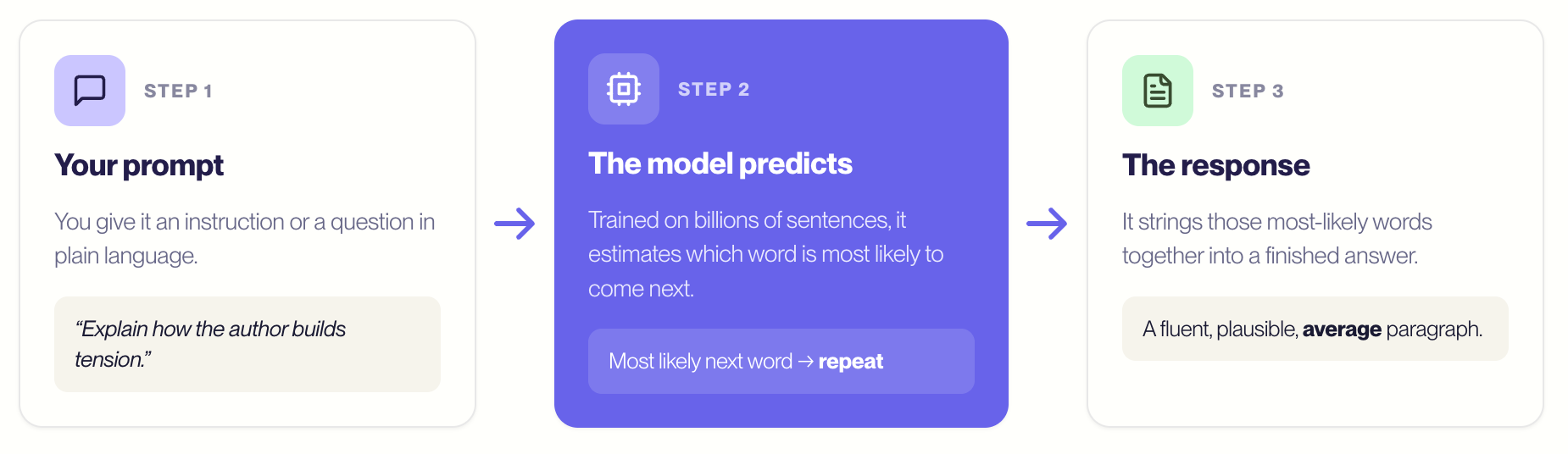
Simply put, a language model trained on thousands of essays about Hamlet will produce a Hamlet essay that sounds plausible and reads exactly like every other AI-assisted response your marker will encounter that day. Understanding this distinction between fluency and quality is the foundation of everything that follows.
What your brain is actually doing when you write an essay
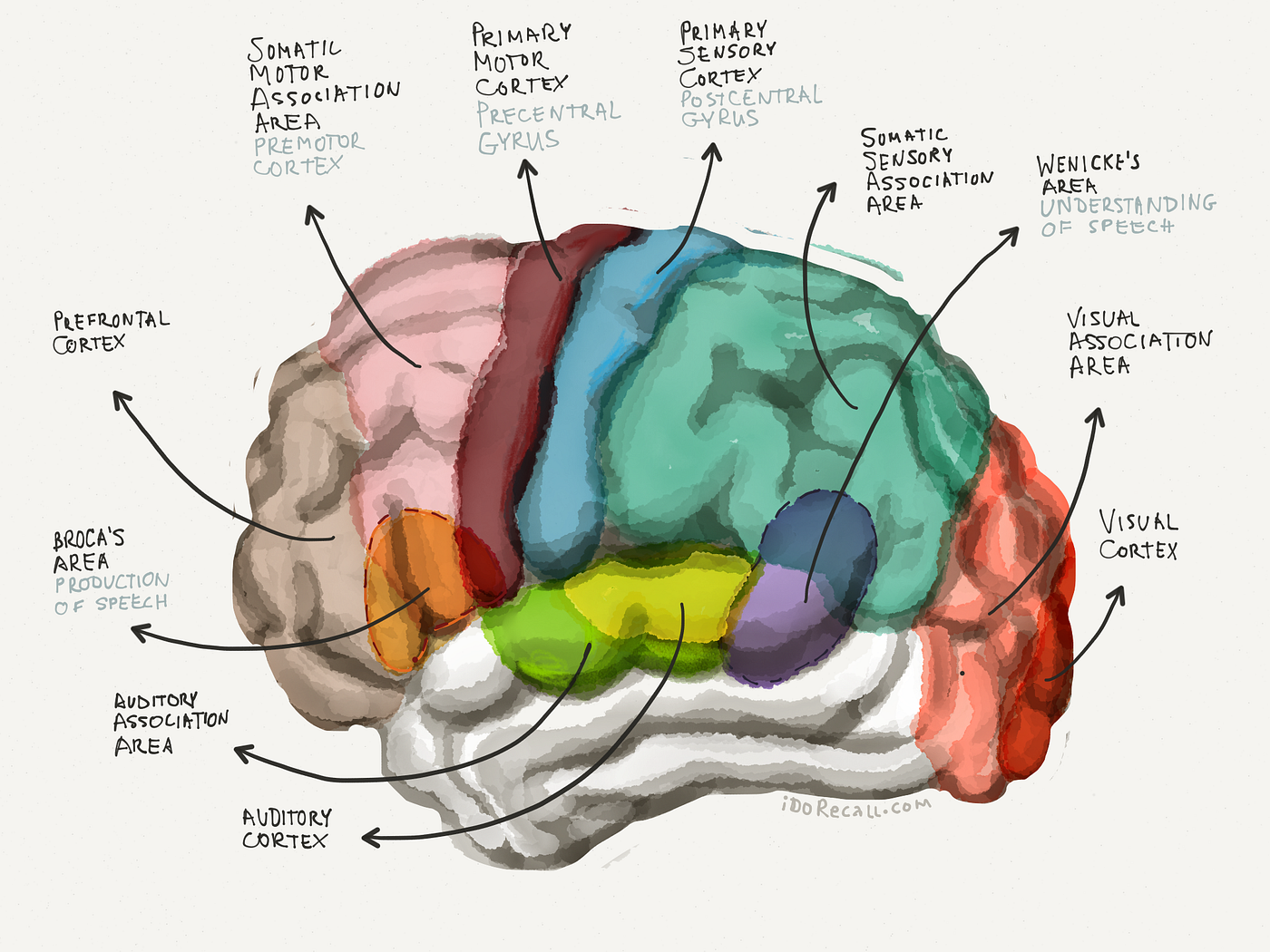
Learning is a physical process. When you sit with a tricky passage of a text, draft a conclusion, or agonise over whether a sentence is doing what you want, your brain is literally rewiring itself. Neurons fire together to build stronger connections. Your hippocampus encodes new information, your prefrontal cortex coordinates the planning and judgement, and over the next few nights of sleep, those traces get consolidated into the long-term knowledge you’ll need to pull from in the exam hall.
But this rewiring only happens in proportion to the effort your brain puts in. Two of the most replicated findings in cognitive science explain why this matters so much for AI:
- The first is the principle of “desirable difficulties,” named by Robert and Elizabeth Bjork. The conditions that make learning feel harder in the moment, struggling to recall something, generating your own examples, working without a scaffold, are precisely the conditions that produce stronger, more durable, more transferable learning. If this feels abstract, imagine the process of training your muscles. Time under tension is what we all seek to maximise, because it is tension that builds muscle, not effortlessness. Similarly, when AI makes the work feel easy, that’s a sign it’s not helping you learn, which may cost you at the end of year.
- The second is the generation effect, first documented by Slamecka and Graf in 1978 and replicated hundreds of times since: information you produce yourself is remembered dramatically better than information you read or are given. When you wrestle a sentence into shape, your brain encodes not just the sentence but the entire web of decisions around it. It considers why this word and not that one, why this structure carries the argument. Reading an AI’s sentence, even an objectively better one, lays down almost none of that.
This is why active recall and effortful retrieval are the most evidence-backed study techniques in all of cognitive science. And it’s why AI shortcuts are dangerous in a way that, say, reading a good textbook and integrating its teachings is not.
Why this hits VCE English students especially hard
English isn’t a content subject you can cram. If you’ve spent the year training the AI instead of your brain, the exam hall will be brutal. And what this MIT study suggests is that the deficit isn’t just “I haven’t practised this skill enough” — it’s measurable at the level of neural networks that were never built in the first place.
There’s also a creativity cost I see constantly in my marking, and the research backs it up. AI-assisted students score well on idea fluency in the moment, but their ideas converge on whatever the model suggests, and originality drops.
Two examples
Tutor-written:
Employing the medical metaphors of “cure” and “disease”, Sophocles affirms Oedipus’ singularity as both a king and healer of Thebes, tasked “free the city from its corruption.” Whilst his responsibility over the polis proves noble, the inadequacy of purely rational approaches to the city’s spiritual sickness contributes to his downfall. As such, Oedipus’ declaration that “the flight of [his] own intelligence hit the mark” in solving the riddle of the Sphinx represents a dangerous overconfidence in human reason’s universal applicability. Indeed, by “ascend[ing] the throne” neither through divine appointment nor inheritance, Oedipus becomes the idealised democratic leader and the collective symbol of political and intellectual achievement; however, the same intellectual and moral qualities that enable his political success paradoxically lead to his downfall. The dismissal of “help from the birds” thus establishes the inevitable collision between human excellence and cosmic forces.
AI-generated
At the beginning of the play, Oedipus is portrayed as a compassionate and responsible ruler who cares deeply for his people. Addressing the citizens as “My children”, he establishes a paternal relationship with them and shows concern for their suffering. He demonstrates empathy when he says, “I grieve for you, my children”, suggesting that he shares their pain. Oedipus is also presented as proactive and capable because he has already sent Creon to seek guidance from Apollo’s oracle. Furthermore, he displays confidence in his abilities, reminding the people that he is “Oedipus, the world knows my fame”. This self-assurance reflects his status as the hero who defeated the Sphinx, but it also hints at the pride that will later contribute to his downfall.
The first example shows a lot more judgement than the second. It pieces together insights from various places, the medical metaphor, the politics of how Oedipus came to the throne, the tension between reason and the divine, and synthesises them into a single argument about why his virtues and his downfall are the same thing. The AI-generated example, by contrast, is competent and correct, but it observes rather than argues. It lists qualities (“compassionate”, “proactive”, “confident”) and gestures at their significance without ever committing to a claim.
The deeper issue is what researchers Fan and colleagues (2024) call “metacognitive laziness.” Metacognition - thinking about your own thinking - is what lets you notice you’ve misread a passage, sense when an argument is shaky, or feel that a sentence is technically correct but tonally wrong. It’s a high-effort process. And when AI offers fluent answers on demand, the temptation is to hand over not just the task but the judging of the task. In the case of the above examples, by relying on AI, you may also lose the ability to recognise why the first one is better.
Habits that will protect your learning
1. Write before you prompt. Always draft your own rough version first, even a messy, bad one and then ask AI to challenge it. As a (personal) rule of thumb, I’d aim for the input into AI to be at least 50% of the output where possible. That 50% is your draft. If you’re looking for AI to turn around 1000 words, your draft or prompt should be at minimum 500 words for there to be enough ‘human’ involvement. This activates the generation effect, forces retrieval practice (which strengthens memory traces far more than re-reading), and means whatever AI gives back, you have something of your own to compare it to. If your first move is asking AI for an answer, you’ve bypassed every step and mechanism that matters in learning.
2. Verify, disagree, and explain why. Treat every AI output as a draft from a confident but unreliable peer. Cross-check claims about texts against the actual text. Most importantly: if you can’t articulate why a suggestion is good or bad, you’re not ready to use it — that’s a signal to go back to the foundations. The act of explaining your judgement out loud (or in a margin note) is itself a metacognitive workout AI cannot do for you.
3. Build “AI-free reps.” Your exam will be AI-free, handwritten, and timed. Your practice has to include AI-free reps that match those conditions: timed essays, handwritten analysis, cold reads of unseen passages. Think of these as the cardio of English study; non-negotiable, uncomfortable, and the thing that actually builds the capacity you’ll need in the room. A 2025 study in Scientific Reports found that AI use enhanced academic outcomes only when paired with strong metacognitive habits. Without those, the same use patterns predicted worse outcomes.
The bottom line
I know the pressure you’re under. I know how tempting it is to let AI take the wheel when you’re tired, behind on a SAC, and watching your ATAR target slip further away. Every time you let AI shortcut the steps that matter, you’re paying down a small amount of cognitive debt that comes due in November. Every time you do the foundations yourself and bring AI in only to spar with, you’re compounding the opposite, building a brain that can use AI well because it doesn’t need to. Your future self in the exam hall — and the markers reading your work — will know the difference.
More on AI use cases soon! Stay tuned.
Related posts

How to write a Crafting Texts response
A step-by-step guide to VCE English Crafting Texts: building your piece around framework ideas, planning purpose and form, experimenting with structure, and responding to the exam title and stimuli.

The VCE English Exam Guide: Structure, Style and Advice for Every Section
A section-by-section guide to the VCE English exam: how to structure Section A, B and C, how to divide your three hours, and what separates top-band responses from the rest.

Is VCE Literature Just the 'Harder' English?
Here are the signs that VCE Literature might actually be easier for you.