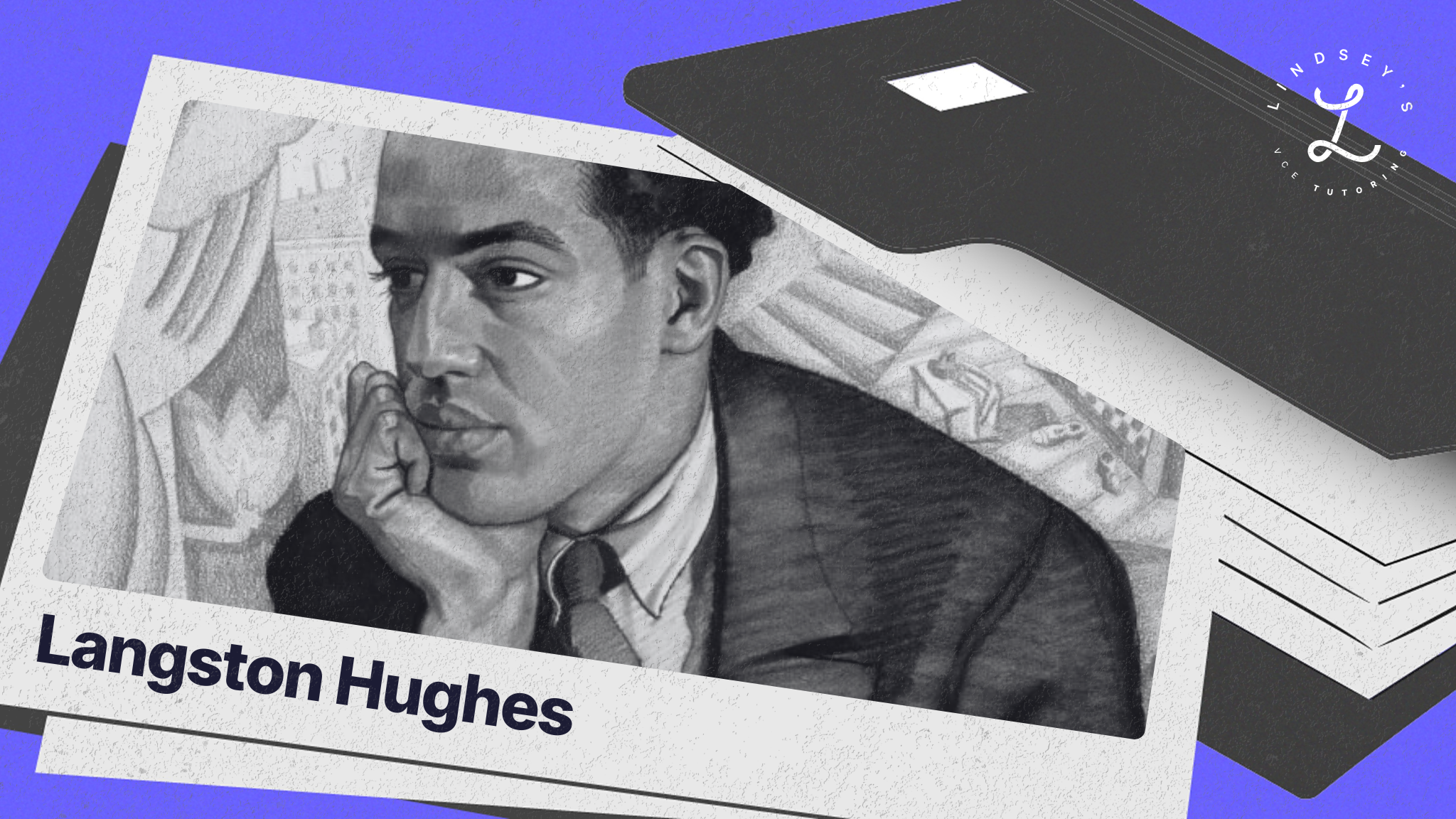
An Ultimate Guide to Langston Hughes

Langston Hughes (1901-1967) was one of the most influential American writers, whose work focused on expressing the African American experience during a time of racial injustice. Born in Missouri at the border between the divided Southern and Northern states of America, Hughes experienced first hand the social issues he wrote about, later studying at Columbia and travelling across America to more accurately write about the racial discrimination that was widespread across the country. Throughout his poetry, Hughes sought to both express the joys of his African American identity but also draw attention to the frequent racial prejudices he encountered.
Context
The collections listed on the study design - 'Afro-American Fragments' (1930), 'Magnolia Flowers' (1927), 'Montage of a Dream Deferred' (1951) and 'Words Like Freedom' (1965) - must all be read within the political and social context of Hughes' America. For Hughes' poetry, the socio-economic context cannot be removed from his works, and a deep understanding is required in order to better interpret his poems.
Although slavery had been abolished in 1865, the echoes of racial prejudice that were fought over in the American Civil War (1861-1865) insidiously prevailed within American society. The legacy of this division manifested in racial segregation across the country, as well as the intense economic disparity between the Northern and Southern states.
As a result, many African Americans from the Southern states - which felt racial discrimination most strongly - sought passage to the North, for both economic and social purposes. Dubbed the Great Migration, this period of displacement lasted from 1910 to around 1970, and Hughes sought to convey the struggles during this period to a wider audience, notably in his collection 'Magnolia Flowers.' Importantly, the Great Migration meant that many African Americans were raised without a formal education, evident in the more informal voice that Hughes takes in many of his poems. In Bound No'th Blues, Hughes conveys the isolation and alienation that African Americans experienced on this journey to find economic opportunities and to escape racial discrimination, while Song for a Dark Girl presents the harsh treatment of black people in the South.
During the 1900s, racial prejudices against African Americans were ubiquitous, codified under the Jim Crow system that forced segregation in all spheres of life; on trains, in schools and bathrooms. In this way, African Americans were seen as subhuman in society, even disenfranchised and unable to vote, all while facing the economic and social oppression that Hughes details in 'Montage of a Dream Deferred.'
However, during the 1920s and largely as a result of the Great Migration, there was a period of cultural and artistic flourishing centred in Harlem that celebrated African American identity, and was championed by Hughes' work. The Harlem Renaissance not only celebrated African American heritage, but also provided a mouthpiece to challenge the racial prejudices that plagued early 20th century America.
Shortly after the Harlem Renaissance, the 1950s to 60s saw the height of the Civil Rights Movement, which saw many famous marches and speeches, such as Martin Luther King Jr.'s famous speech, lead to the creation of several legislations that codified civil rights, including the rights to vote.
Key textual features
Poetic form and jazz
Hughes' poetry was associated with jazz poetry, a comparatively simpler prose that allowed his political and social views to be accessible to a larger and uneducated audience, while relying on rhythm and at times informal phrasing to make his works sound like song lyrics. As a result, the common structure of his poems are either split into shorter stanzas - much like song chorus lyrics such as in Ballad of the Landlord- or take on a more conversational tone, reflected in larger blocks of writing without line breaks, as found in Deferred.
Chiastic structure and anaphora
Many of Hughes' poems include a chiastic structure, where the first line of the poem or stanza is the same as the last line in the poem or stanza, forming an A-B-A pattern. This helps to create the song-like structure that characterised Hughes' poetry, evident in Negro where the stanzas are repeated much like verses and choruses of a song. Moreover, the chiastic structure is also used to demonstrate the continuance of a certain struggle, such as in Deferred. Here, the repetition of lines at the start and end of stanzas represents the inescapability of racial prejudice, still remaining despite the time that has passed in the poem and in history.
Similarly, Hughes employs anaphora, which is the repetition of a phrase of words at the beginning of separate lines to a similar effect. In I, Too, the titular phrase "I, Too" is repeated at the start and end - while initially a resigned acknowledgement of racial oppression, is transformed at the end as the anaphora highlights the change in tone to a more hopeful assertion of identity.
Enjambment
The majority of Hughes' work contains enjambment, where the sentence continuing over to the next line mimetically reflects the ongoing or widespread nature of the particular struggle that Hughes illuminates. For example, in Necessity, the enjambed lines running over represent the almost never-ending cycle of "nothing // but eat, drink, stay black and die." Enjambment is also used by Hughes to contrast with end-stopped lines, while also aiding Hughes' creation of an uneducated African American voice - as was common in the early 1900s.
Polysyndeton
Another common literary device that Hughes employs is polysyndeton; the use of excessive conjunctions. While polysyndeton can similarly create the effect of a continuously ongoing event or the widespread universality of a struggle, such as in Aunt Sue's Stories, Hughes also uses polysyndeton to again evoke the more informal and conversational tone adopted throughout his works. In doing so, Hughes renders his poetry, and hence his depictions of social and racial injustices, more approachable and easier to understand for his wider audience.
Themes
Celebration of African American identity and culture
One of Hughes' key concerns in his work was to celebrate African American identity with pride, against the grain of racist ideology which profiled Black people as less civilised and 'primitive'. In his poem collection 'Afro-American Fragments,' Hughes lambasts this false narrative by detailing the rich African American culture from a Black perspective. In The Negro Speaks of Rivers, he establishes the deep history of African American people, recounting their storied presence throughout historical events with allusions to the slave-constructed "pyramids" by the "Nile" and "Abe Lincoln['s]" first shocking discovery of slavery. Hence, Hughes memorialises the enduring history of the African American identity.
Moreover, Hughes establishes the cultured stories found in oral history in the poem Aunt Sue's Stories. As many African Americans were raised in conditions that denied them a formal education, most of their history came in the form of spoken stories, not "out of any book at all."
White supremacist ideology also framed the Black arts as unsophisticated and inferior, a notion likewise invalidated in Sun Song. By emphasising the connection between African American culture and "the song of all the sun-stars," - elevated by the celestial connotations of "sun," - Hughes foregrounds the validity, presence, and unique beauty of African American arts. Indeed, Hughes establishes artistic self expression as a vehicle for fostering community and escaping racial prejudice, as symbolised by the "white day" in Dream Variations that the poetic speaker escapes by "whirl[ing] and [...] danc[ing]" to reunite with the "night," that is "dark like [them]." For Hughes, the arts provide a method of self expression that allows him, and the wider African American community as a whole, to seek respite and community from the racial prejudices they face as well as a mouthpiece to contest the racial oppression they faced.
Racial prejudice, segregation and violence
Despite the ubiquitous nature of racial prejudice in early 1900s America, Hughes sought to draw more attention to the daily racial oppression that African Americans faced in early 20th century America. Hughes starkly condemns the racial segregation under the Jim Crow laws in I, Too from the poem collection 'Magnolia Flowers.' By creating familial imagery and comparing African Americans to the "darker brother," sent away "to eat in the kitchen," despite being "America [...] too," Hughes implores his white readers to "be ashamed," for enabling segregation and drawing greater attention to its inherent injustice.
Hughes further draws attention to the more physical racial violence that African Americans faced, whether at the hands of the notorious KKK in Ku Klux who "took" African Americans from their homes to torture and kill them for the sake of the "great white race," or the crowd led lynching exposed in Silhouette. These poems are drawn from Hughes' personal experiences travelling in the South, where he witnessed black men being "hung" to "roadside tree[s].'' These poems thus serve as both a mourning and a condemnation of racial violence post-slavery, challenging the flimsy justifications which enabled these horrific crimes to continue.
Indeed, Hughes dismantles the very notion of a 'post-slavery' era, exposing in Porter that the hierarchical view of African Americans existing only in servitude still existed in the 1930s, through the economic and social standings of the "rich old white [men]" over them. This parallels the poem Share-Croppers, where Hughes exposes the brutal treatment of slaves who were framed as if a "herd" of cattle, while bringing to light the inseparability of slavery to America's history as a "great mistake [...] made long ago," in American Heartbreak.
Thus, Hughes lays bare the tacit connections between capitalism and slavery in early twentieth-century America, revealing how racist inequality continues to be perpetuated under the guise of market logic and economic rationality. Regardless, Hughes allegorises the African American community to the titular and eponymous "Magnolia flowers," who despite being forced to grow in the "corner full of ugliness" and brutality, still bloom and persevere through racial oppression that surrounds them.
Inescapability of racial oppression and its effect
In his collection 'Montage of A Dream Deferred,' the poem Deferred crystallises that from an African American perspective, even the mere dream of a "white enamel stove," is delayed for "eighteen years," due to the immense disadvantages brought by the racism black Americans faced. Indeed, even class mobility - metaphorised by the "two new suits" the poetic speaker wishes to buy, but cannot - is rendered merely a "dream" that is ultimately "deferred" by racial oppression.
As a result, the dreams of African Americans are rendered entirely an uncertainty due to the disadvantages they face, which Hughes reveals in perhaps his most famous poem, Harlem. The numerous grotesque hypothetical questions reflect the unsteady course of many black people's dreams, which are only doomed to "dry up / like a raisin in the sun," drained of any life under the oppressive heat of racial prejudices.
The poem Blue Bayou laments the seemingly inescapable and all encompassing nature of this oppression, allegorising its cyclical nature in the treacherous terrain of the "blue bayou" that remains everyday, emphasised by the repetition of the "sun go[ing] down" yet the crushing conditions persist unchanged. In this way, Hughes illuminates the stifling yet inexorable conditions that African Americans lived under in the 1920s.
Hope for racial unity
Despite the overwhelming racial oppression that Hughes outlined in his works, a key theme in his poetry was the overlying hope for racial unity, most notably in his collection 'Words Like Freedom.' In Freedom Train, Hughes uses the transportative symbol of the train as a hope for a future free from racial oppression, most importantly free from the segregation of the "Jim Crow" laws. Yet the "freedom train" itself represents more than the dream of ending segregation, extending this hope towards "ballot boxes" and the ability to escape the confining definition as a "porter," – a dream of greater freedom and prosperity.
Hughes also presents the dream of closer knit racial unity, as found in Daybreak in Alabama. Although Alabama was one of the most racially divided Southern states, Hughes depicts freedom growing like "tall trees" nurtured by "white hands / and black hands and brown and yellow hands," as the polysyndeton aids the universality of Hughes' vision of an America defined by collective unity.
As Hughes himself was born of mixed race, with his parents both having mixed ancestry, he also explored life in 1920s America from the perspective of a biracial person, who faced alienation from both black and white communities, revealed in poems in 'Magnolia Flowers' such as Cross and Mulatto. His dreams of unity are perhaps informed by such experiences, as he reveals how rigid racial and ethnic boundaries only serve to dehumanise.
Conclusion
Overall, Hughes' poetry operates as both a form of cultural celebration and political protest, grounded firmly in the historical realities of early twentieth-century America. Through accessible jazz-influenced forms and recurring structural devices, Hughes foregrounds the lived experiences of African Americans navigating segregation, economic exploitation, and racial violence. Yet, alongside this exposure of systemic injustice, his work consistently affirms Black identity, artistic expression, and the enduring hope for racial unity. In doing so, Hughes transforms poetry into a vehicle for resistance, remembrance, and re-imagining a more equitable American future.
Quiz Time!
How does Langston Hughes explore racial identity in his poetry?
Click to reveal answer
Hughes challenges white supremacist narratives by foregrounding the deep history and cultural richness of African Americans. He presents artistic expression as a vehicle for community, resistance, and escape from racial prejudice. He also explores biracial alienation, revealing how rigid racial boundaries dehumanise.
What are the key themes in Langston Hughes' poetry?
Click to reveal answer
Hughes' poetry centres on celebrating African American identity, exposing racial prejudice and segregation, the inescapability of racial oppression, and hope for racial unity.
What is jazz poetry and how does Langston Hughes use it?
Click to reveal answer
Jazz poetry draws on the rhythms and repetition of jazz music to create an accessible, song-like style. Hughes used it to structure poems as short chorus-like stanzas or larger conversational blocks, making his social and political commentary approachable for audiences without formal education.
What literary techniques does Langston Hughes use?
Click to reveal answer
Hughes frequently uses enjambment, polysyndeton, chiastic structure, and anaphora to reflect the ongoing and cyclical nature of racial struggle. His jazz poetry style — rhythmic, informal, and structured like song lyrics — made his political commentary accessible to a wider audience.
What is the historical context of Langston Hughes' poems?
Click to reveal answer
Hughes wrote during a period shaped by the legacy of slavery, Jim Crow segregation, the Great Migration, and the Harlem Renaissance. Although slavery was abolished in 1865, racial prejudice persisted through legal segregation, disenfranchisement, and economic disparity. His collections span from the 1920s through to the Civil Rights Movement of the 1960s.
Related text guides

An Ultimate Guide to Orbital
Samantha Harvey’s Orbital (2023) follows a single Earth day in the lives of six astronauts aboard the international space station (ISS), hundreds of miles above earth. As they complete sixteen orbits and witness sixteen sunrises and sunsets, their distant view of Earth encourages reflection on the planet’s beauty, fragility, and the broader significance of human life.
An Ultimate Guide to Ghost Wall
Sarah Moss is a contemporary British novelist, born in 1975 in Glasgow, Scotland. She is known for her literary fiction, including her novels and novellas, and typically explores themes surrounding history, loneliness, family tensions, personal relationships, patriarchy, and women’s roles in society.

An Ultimate Guide to Bad Dreams and Other Stories
Tessa Hadley, born in Bristol in 1956, is a British author most famous for her novels, her short stories, and her non-fiction writing. The main concerns of her writing are usually human relationships, domestic lifestyles, and family dynamics, and her writing is usually realistic rather than fantastical.