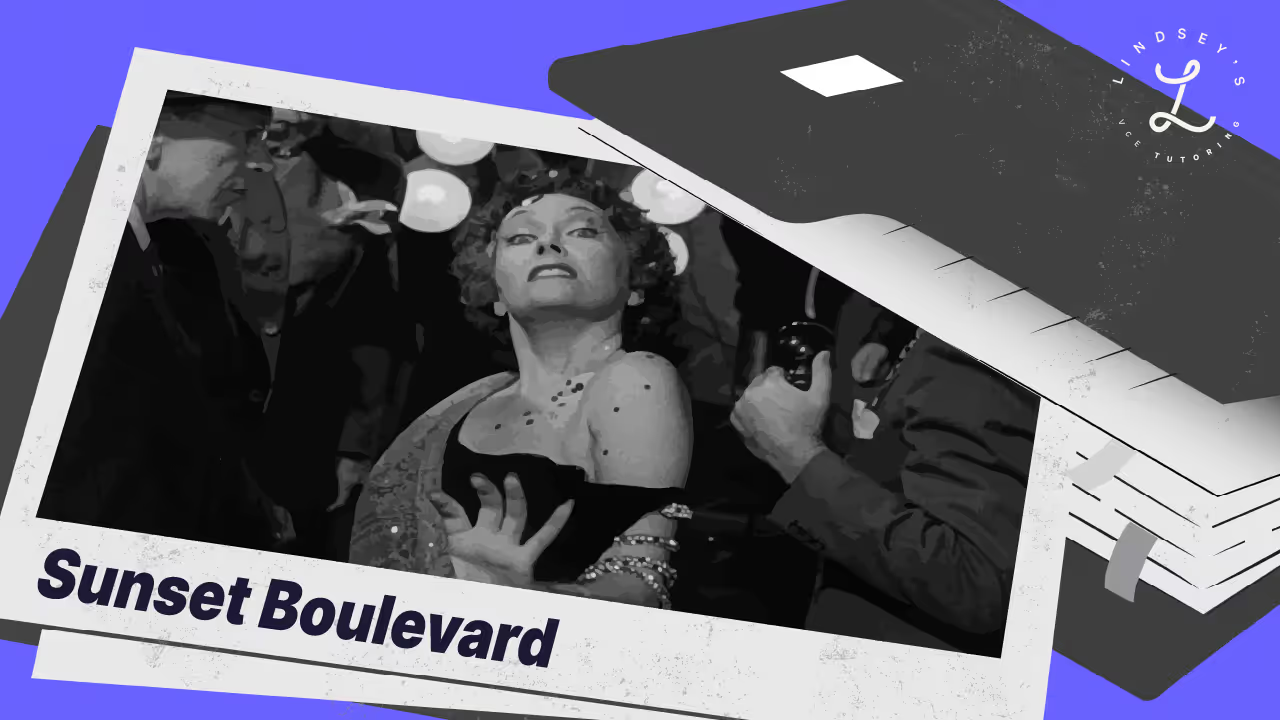
An Ultimate Guide to Sunset Boulevard by Billy Wilder

Sunset Boulevard is a 1950 film noir written and directed by Billy Wilder. It follows Joe Gillis, a struggling screenwriter, as he stumbles upon former movie star Norma Desmond. The latter persuades Joe to help her make a comeback by all means necessary. Named after a major street in Hollywood, the film explores the darkness in the glamour of the American film industry.
Synopsis
The film begins as a group of police investigators examine Joe Gillis’ body in a pool of a mansion on Sunset Boulevard. Joe recounts the events leading up to his death from six months prior.
Then, Joe was a struggling screenwriter who hoped for his new story to generate some interest from Paramount Pictures. The story was heavily criticised by script reader and aspiring writer Betty Schaefer. Joe was later running away from repossession people who were after his car. Here, he hid in a driveway of a mansion he thought was abandoned. The mansion actually belonged to Norma Desmond, a silent movie star who was no longer in her golden years. Upon learning that Joe was a screenwriter, Desmond asked his opinion on her screenplay about princess Salome. Joe found the script horrible but sweet-talked Desmond into hiring him to fix her script.
Joe became a frequent occupant at the mansion, partially against his will. He learnt about Desmond’s obsession with returning to her life of fame and love. He also learnt that the fan letters she received had been sent by her butler, Max. Came New Year’s Eve, Joe realised Desmond had fallen in love with him. Upon rejection, Desmond stormed into her room. Joe went to his friend Artie’s party, whose middle-class liveliness was the opposite of the atmosphere at the mansion. Joe met Betty again, who was revealed to be engaged to Artie, and claimed to see potential in one of the scenes in Joe’s earlier screenplay. Their talk is interrupted by a call from Max telling Joe that Desmond had slit her wrists. Joe returned to Desmond and the two became lovers.
The edited screenplay of Salome was sent to Cecil B. Demille, a former director of Desmond-led pictures. The mansion then received multiple calls from Paramount Pictures but not from Demille himself, thus were refused by Desmond. Max later drove her to the studio to meet Demille in person. Desmond was greeted with respect out of courtesy and mistook it for her finally making a comeback. Max learnt that the calls from Paramount had been to ask to rent the exotic car Desmond had for a film. Desmond was not disclosed of this. She went on rigorous beautifying treatment while Joe snuck out at night to meet Betty and wrote an original screenplay with her. In these nights, they fell in love, despite Betty’s engagement.
Max learnt of this affair and revealed to Joe that he was a former director who had discovered Norma Desmond and later had married her, then became her butler. Norma learnt about the affair too, through a manuscript with Betty and Joe’s names written on it. She called to clue Betty in on the fact that Joe was not who he seemed. Betty was then invited to the mansion by Joe. In the climax, Joe told Betty he was Desmond’s gigolo, and after Betty’s departure, he decided to leave himself, back to his Ohio newspaper job. Desmond then threatened to kill herself but Joe dismissed her. She aimed and shot at Joe instead, murdering him, letting his body drop into her pool.
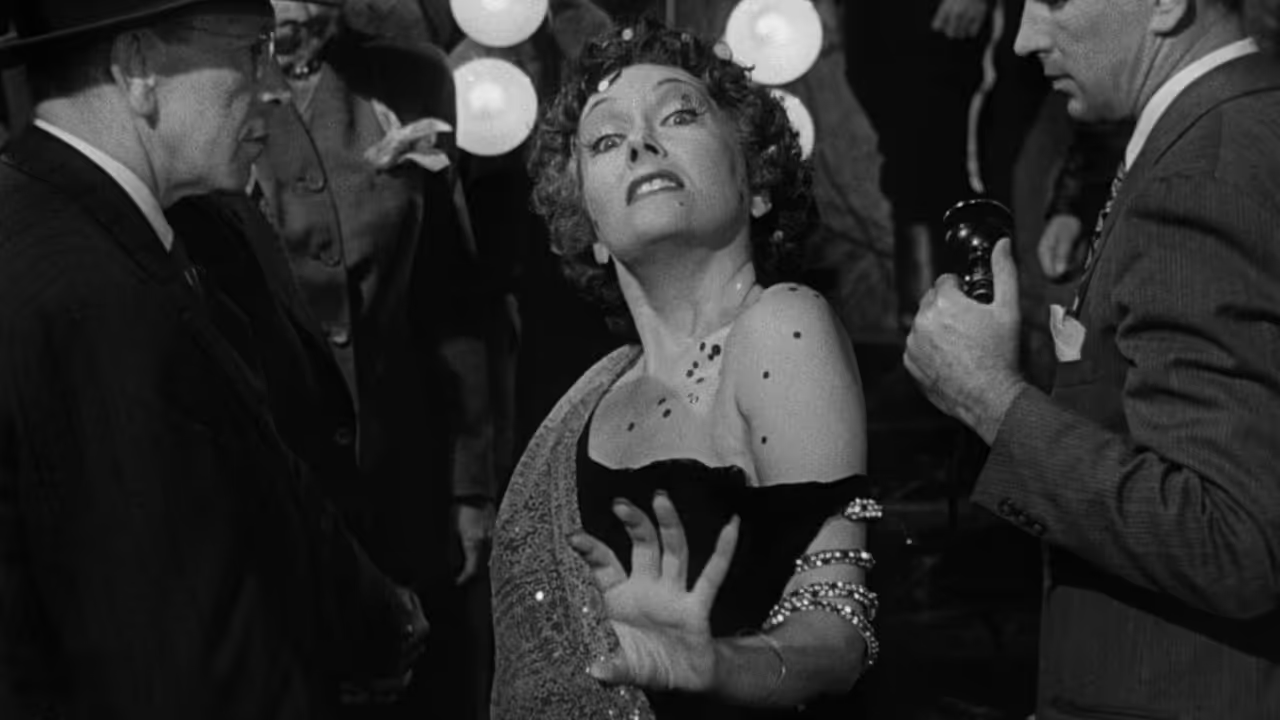
The flashback ends and Desmond descends her stairs to meet policemen and the press. Under the illusion that newsreel cameras are to film her movie Salome, Norma Desmond gave a speech in appreciation of her return to glamour, ending with “All right, Mr. DeMille, I'm ready for my close-up.”
Film devices
Posthumously narrated by protagonist Joe Gillis, Sunset Boulevard is told in a noir-style non-linear fashion. The film’s production design is of note here, upholding noir filmic tradition of juxtaposing and underlining light and darkness. The Desmond estate perfectly captures the washed-up state of its owner. Though the outside is a Spanish-style mansion like many in Beverly Hills, the inside is decrepit, dusty, and gothic - a symbol for the facade Desmond lives in and her true nature as a relic from a time passed. “The whole place seemed to be stricken with a kind of creeping paralysis”, says Joe as he walks the dark hallways of the mansion. “out of beat with the rest of the world, crumbling apart in slow motion.” All the photos hung around the estate are of Desmond, but all of her from her golden days, symbolising her reluctance to face the reality that is her obsoleteness. Not just the objects, all the characters around her contribute to the prevalence of her illusion.
Themes
Sunset Boulevard sheds light onto the shadow casted by 1950s Hollywood’s glee and glamour. This black comedy film noir explores the concepts of fiction and reality, the darkness of celebrity and fame, as well as gender constructs. Such topics are illuminated by lead characters Joe Gillis and Norma Desmond in the pursuit of their desires and the relationships they have.
Fiction and Reality
The story is predicated on fantasies, blurring the lines between what is real and what is not. Much of the inciting incident - Joe meeting Desmond - is due to a lie. Joe lies to repossessors about his car being in Palm Springs, and when the truth comes out, Joe has to drive the car into Desmond’s driveway to escape. This action leads to consequences that finally result in Joe’s death. This seemingly insignificant detail set a precedent for the rest of Wilder’s noir - that all lies unravel and the consequences are unpredictable. Norma Desmond’s shadowy figure is the dark embodiment of the Hollywood dream machine. As an obsolete sweetheart of a bygone era, Desmond deludes herself into thinking she can make a return to fame.
Her butler and former husband, Max, writes and sends her dozens of fan letters to let her think she still has a following; Cecil B. Demille celebrates her visit to the studio and avoids talking about her screenplay so that Desmond is not dejected. Joe, too, refuses to tell Desmond his true feelings about her screenplay. “You don’t yell at a sleepwalker”, he says. Sometimes, however, delusions fail her. Max says there have been “moments of melancholy” and “many suicide attempts”. One of which is on New Year’s Eve, when Joe rejects her. Joe has been under the illusion of obliviousness as he couldn’t tell from all the luxurious gifts Desmond’s affection. Desmond has made Joe an illusion of her own, as well - dreaming of them living happy years together. Just as she thinks she is still a young star, Desmond believes the much younger Joe Gillis to be her gentleman. When such fantasy crumbles, Desmond loses her will to live, and is surrounded by vanity on New Year’s Eve, with confetti, and live music in her giant mansion. Upon hearing this news, Joe rushes to see her. However, Max tells him to not run because the musicians must not know.
Even in a situation as dire as mortality, the Desmond estate must keep up appearances, which underlines its relentless efforts in maintaining illusion over reality. When illusion fails her this time, she seeks her demise; the next time illusion wavers, she seeks that of her lover, and she finds it. Joe Gillis is killed by Desmond, not because he breaks her heart by leaving, but because he ruins Desmond’s delusion of stardom. “No one leaves a star,” she whispers in the foreboding silence, “that’s what makes one a star.”
The film’s final scene is when Joe Gillis has already died and is no longer the narrator. Without his point of view, the film takes a neutral stance, making the ending akin to reality. Here, Desmond’s illusion brings her to her end. She believes she is filming a scene for her film Salome, but in truth is walking her way into police custody. As she steps down the spiral staircase, photojournalists snap her photos, and others are mortified by her lack of remorse for the crime she did. The horror is escalated by Franz Waxman’s score, boasting the horrifying image of Norma Desmond having undergone a total break from reality.
Stardom and Vanity
Sunset Boulevard also offers a heavy critique of contemporary Hollywood, unravelling the nightmares behind the curtains of the dream machine, particularly the vanity that the star system perpetuates. Norma Desmond is a silent film star whose glory days are behind her; she is played by Gloria Swanson, a famous silent-era actor herself. Norma has a toxic characterization of Hollywood and its obsession of image has rubbed off on her. Sunset Boulevard predominantly shows Norma in front of mirrors, snapshots of her old photographs, and her “celluloid self”. These details put an emphasis on Desmond’s refusal to accept her fading stardom, and by extension, the dangerous appeal of intoxicating fame.
It also paints an illustrative picture of the movie-making business’ fetishization of youth. “Norma Desmond? She must be a million years old” says an executive, demonstrating the quick-to-change nature of celebrity life, and the downward spiral it promises. The film also features numerous actors that were former Hollywood cultural symbols, including silent film director Erich von Stroheim as Max, and silent king of comedy Buster Keaton in a cameo. Joe Gillis is also a victim of Hollywood’s toxicity. Though talented, Joe is cynical and jaded, often giving in to vanity over creating artistic work. Contextually, the studio system in 1950s Hollywood displaced many workers in the film industry, especially writers. Being confined to his Ohio newspapers job, Joe is no longer hopeful of his filmmaking career, or rather, unable to create works that are meaningful to him due to his focus on scripts that he thinks will sell. This encapsulates the contemporary Hollywood’s system that allows executive meddling to affect storytelling, placing what might be profitable over what is original. “That was me [who turned down Gone with the Wind].” an executive bitterly says he did not expect people to want to see a film about the Civil War.
Dreams and Ambition
A screenwriter himself, Billy Wilder uses Joe Gillis’ character to vent his frustration about the lack of acknowledgement and respect film writers have, among other parts of the movie making machine. Through that, Billy Wilder criticises the celebrity worshipping culture attached to Hollywood that glorifies the image of actors and stars, but not the ones behind the construction of the dreams: “Audiences don’t know somebody sits down and writes the picture, they think the actors make it up as they go along” - Joe laments.
Opposite to both Joe Gillis and Norma Desmond is Betty Schaefer, a 22-year-old script writer who aspires to be a screenwriter. Her optimistic outlook as a young person and passion for movies become her drive to create stories that break away from the restraints of Hollywood at the time. Joe condescends her at first, but soon warms up to her dedication and begins writing for himself. Betty’s character is a beacon of positivity and Billy Wilder’s selectee to be the spearhead of the film industry’s future in this movie. She represents the direction Hollywood should be in: championing passion, love, and courage. Betty is also a counter force to Norma Desmond. The film reveals that Betty once tried to be an actor, but decided to change her path because she does not wish to submit to the screen’s obsession with image. This is opposite to Norma Desmond, who refuses to stop feeding into Hollywood’s toxic star system and tirelessly grips onto her slipping past.
Gender Roles
Sunset Boulevard also examines gender roles in contemporary America through the relationships the characters have with each other. The film both subverts and adheres to classic gender norms; and the same goes for film noir traditions. Leading man Joe Gillis, in his relationship with Norma Desmond, does not embody normative masculinity, which is often synonymous with strength, domination, and aggression. Here, he becomes submissive and subservient to Norma Desmond and her many wishes and desires, he also is threatened by her. Desmond, on the other hand, instead of being compliant like devised by normative femininity, holds power. She manipulates Joe into being her screenwriter and later, her lover. She also holds command over Max, her former husband turned butler, and even Cecil B. Demille. Joe’s passivity and emasculation set him aside from other antiheroes in film noirs, who often are just as charming as Joe, but embody more influence and agency. When trying to reclaim his masculinity, Joe is shot dead by Norma Desmond, the femme fatale. The murder weapon is a gun, which is often seen as a phallic object in media, symbolizing masculine strength. Like other femme fatales in noir films, Desmond also epitomises postwar America’s consumerism and woman agency. Her Beverly Hills home is enormous with ostensible ceremonies on special occasions and she buys expensive clothes as presents for Joe. Some notions of normative femininity still apply to Norma Desmond, however, as she is obsessed with her image. She has to endure many procedures of beauty treatments to conform to Hollywood’s patriarchal expectations of her as a celebrity actor. Similarly, Betty Schaefer was turned down a role when she auditioned due to her unattractive nose; she had it changed and people could not stop talking about her nose instead of paying attention to her acting. Betty, after this, becomes an aspiring writer, signalling her escape from the superficiality of traditional feminine notions that are subjected upon her by a toxic Hollywood, one that fetishises physical beauty and youth.
Quiz Time!
What is Sunset Boulevard about?
Click to reveal answer
Sunset Boulevard (1950) is a film noir directed by Billy Wilder. It follows struggling screenwriter Joe Gillis, who becomes entangled with faded silent film star Norma Desmond. The film critiques Hollywood's obsession with fame, youth, and illusion.
How is gender portrayed in Sunset Boulevard?
Click to reveal answer
Wilder subverts traditional gender norms: Joe is submissive and financially dependent on Norma, while Norma is dominant and controlling. Yet Norma is ultimately vilified for her power. Betty Schaefer is presented as the healthier model — passionate and authentic rather than image-obsessed.
What are the main themes of Sunset Boulevard?
Click to reveal answer
The film explores the blurring of fiction and reality, the destructive nature of fame and vanity, gender roles, and the exploitation of creative workers in Hollywood. Wilder uses the relationship between Joe and Norma to critique the industry's star system.
What does Sunset Boulevard say about Hollywood?
Click to reveal answer
Wilder critiques Hollywood's fetishisation of youth and image, and its exploitation of writers like Joe. The studio system is shown to discard people once their commercial value fades, leaving figures like Norma stranded — relics of a bygone era unwilling to face obsolescence.
How does Sunset Boulevard explore illusion vs reality?
Click to reveal answer
Norma Desmond lives entirely within a self-constructed delusion of stardom, enabled by Max's false fan letters and Joe's dishonesty. Wilder suggests all lies eventually unravel — Norma's break from reality culminates in murder and her final descent into madness.
Related text guides

An Ultimate Guide to Langston Hughes
Langston Hughes (1901-1967) was one of the most influential American writers, whose work focused on expressing the African American experience during a time of racial injustice.
An Ultimate Guide to Orbital
Samantha Harvey’s Orbital (2023) follows a single Earth day in the lives of six astronauts aboard the international space station (ISS), hundreds of miles above earth. As they complete sixteen orbits and witness sixteen sunrises and sunsets, their distant view of Earth encourages reflection on the planet’s beauty, fragility, and the broader significance of human life.
An Ultimate Guide to Ghost Wall
Sarah Moss is a contemporary British novelist, born in 1975 in Glasgow, Scotland. She is known for her literary fiction, including her novels and novellas, and typically explores themes surrounding history, loneliness, family tensions, personal relationships, patriarchy, and women’s roles in society.